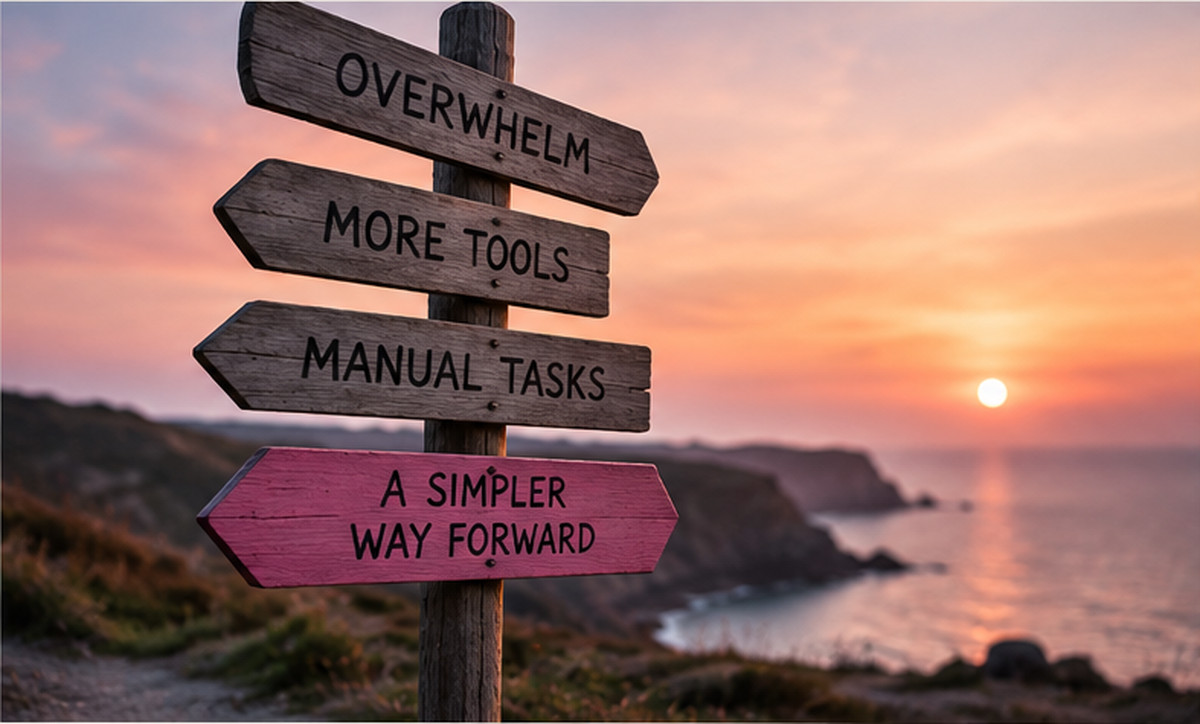
Better systems, not more chaos: where business owners should start
Most small businesses don’t set out to build a complicated operation.
They start with a few customers, a way to take payments and perhaps a spreadsheet. Then the business grows. Another tool gets added. A new process solves an urgent problem. Someone creates a workaround because the original system doesn’t quite fit.
Before long, the business owner is spending an extraordinary amount of time keeping all those moving parts together.
The solution often isn’t another app. It’s understanding what the business actually needs to do.
Look at where your time really goes
Forget the software for a moment. Think about an ordinary working week.
Which tasks are repeated? Which questions do you answer over and over? Where do you need to check information in more than one place? What regularly gets delayed because someone is waiting for you?
Try listing those frustrations as they happen rather than relying on memory at the end of the week.
You might discover that handling enquiries takes too many steps, that customers keep asking for updates or that gathering information for invoices consumes an afternoon.
These small irritations are often more revealing than a large strategic plan.
Find the underlying problem
A recurring frustration is a symptom. The cause may be somewhere else.
For instance, an overflowing inbox could mean you need better email software. But it could also mean customers aren’t getting clear information after buying, enquiries have no consistent intake process or every decision has to go through one person.
Automating emails won’t fix all three of those problems.
Ask what should be happening, what happens now and why the gap exists. Then decide what needs to change.
Put the important information in sensible places
Many growing businesses have customer details in one system, project notes in another, files in a third and decisions scattered across email or messaging apps.
That makes even straightforward work surprisingly difficult.
You don’t necessarily need one enormous all-in-one platform. You need to know which system is responsible for which information and how people or tools get the details they need.
Choose a clear home for key records. Set simple naming conventions. Avoid collecting the same information repeatedly. Keep access proportionate to the work being done.
It’s not glamorous, but it makes almost everything else easier.
Decide what should be automatic
There are lots of tasks that don’t need your judgement every time.
An enquiry can be acknowledged automatically. A completed form can create a draft customer record. An approved project can trigger a checklist. A weekly update can draw from information that’s already being recorded.
These are good candidates for automation because the next step is predictable.
But be careful about automating personal, commercial or sensitive decisions. Complaints, unusual customer circumstances and complex recommendations may still need a human response.
The aim is to reduce repeated administration, not remove care or accountability.
Give AI a job, not a starring role
AI can be helpful for preparing first drafts, summarising notes, organising research and making existing information easier to find.
It can also sound convincing while being wrong. It doesn’t automatically understand the business, and confidential information shouldn’t be shared with tools without considering privacy, contracts and appropriate controls.
Start with a specific task and a clear definition of what a good result looks like. Decide what a person needs to check before the output is used.
If you can’t describe the job, you’re probably not ready to automate it.
Make one useful improvement first
Choose one process that causes frequent friction but isn’t too risky to change.
Document how it works today. Remove unnecessary steps. Clarify who owns the result. Only then look at whether existing software can help or whether a small new tool is justified.
Measure the difference. Perhaps it saves half an hour per enquiry, reduces mistakes in orders or stops customers from having to ask for updates.
A small improvement that works every day is worth more than an impressive system nobody wants to use.
Build a business that doesn’t need you in every step
Better systems can create breathing room. They can make a business more consistent, easier to run and less dependent on one person’s memory.
But they should fit the way you want to work, not force you into someone else’s idea of the perfect business.
Start with the outcome. Understand the work. Make sensible choices about people and technology.
And if you’re not sure what the real problem is, that may be exactly where a fresh perspective helps. Tell Book Bubble Press what’s becoming unnecessarily difficult. We can help you identify what is worth fixing first.